Unbiased Growth Intelligence, in partnership with Owen James
THE NEW RULES OF ADVISER GROWTH
Every year around two million people in the UK look for financial advice. Only about 30,000 of them hold £1m or more in assets — and it is those clients most firms are built to serve. The prize is fixed and increasingly contested. That is what a hypercompetitive market looks like, and it changes what growth requires.
- 19.10.2026
- 5 Minute Read
In Brief
The pool of high-value clients is not growing anywhere near as fast as the number of firms competing for it.
Put together, these forces mean organic growth is becoming harder, more expensive and less predictable. The traditional acquisition playbook, on its own, will no longer carry an ambitious growth plan.
The future of advice will not belong to those who simply chase more clients — it will belong to those who win the right ones efficiently, and build smarter businesses around them.
Every year around two million people in the UK look for financial advice. Only about 30,000 of them hold £1m or more in assets — and it is those clients most firms are built to serve. The prize is fixed and increasingly contested. That is what a hypercompetitive market looks like, and it changes what growth requires.
For decades, successful advice firms have grown on an age-old formula: strong relationships, trusted reputations, and a steady flow of referrals. It served the profession well, and the instinct behind it — that trust is the foundation of advice — is still right.
But the arithmetic beneath it has changed. Across our recent conversations with advice and wealth leaders — at Winning Advisers North, WealthTechMatters, and our spring briefing series with CEOs, COOs, CFOs and Heads of Wealth — one fact keeps reframing every strategy discussion: the pool of high-value clients is not growing anywhere near as fast as the number of firms competing for it.
Rising financial complexity, longer retirements, intergenerational wealth transfer and growing demand are all bringing more people into the market. Yet of the roughly two million who seek advice each year, around 520,000 go on to appoint a new adviser, and only about 30,000 hold £1m or more in assets. That last figure is the one that matters, because it is the segment most firms are designed around — and it is barely moving.
A fixed prize, contested by more firms with more capital behind them, is the definition of hypercompetition. And it rewrites the rules of growth.
About the research
The Growth Intelligence series combines proprietary market research from Unbiased with strategic insight gathered through Owen James communities. The Growth Intelligence series combines:
Proprietary market research from Unbiased
Strategic insight gathered through Owen James communities
Executive discussions with CEOs, COOs, CFOs and Heads of Wealth
Adviser perspectives and market intelligence
The findings draw on discussions held across events including Winning Advisers North, WealthTechMatters and Owen James leadership briefings.

Chapter 1
What happens when more firms compete for the same prize?
The pool of high-value clients is not growing anywhere near as fast as the number of firms competing for it, creating a market where capital, cost and capacity are reshaping the economics of growth.
Three forces are tightening around that same small pool at once.
Capital.
Consolidation is accelerating. Roughly one in five advisers now works for a private-equity-backed firm, and assets under management in those businesses have more than doubled — from £210 billion to £484 billion between 2023 and 2026. That capital is not patient. It is actively bidding for the same high-value clients everyone else wants.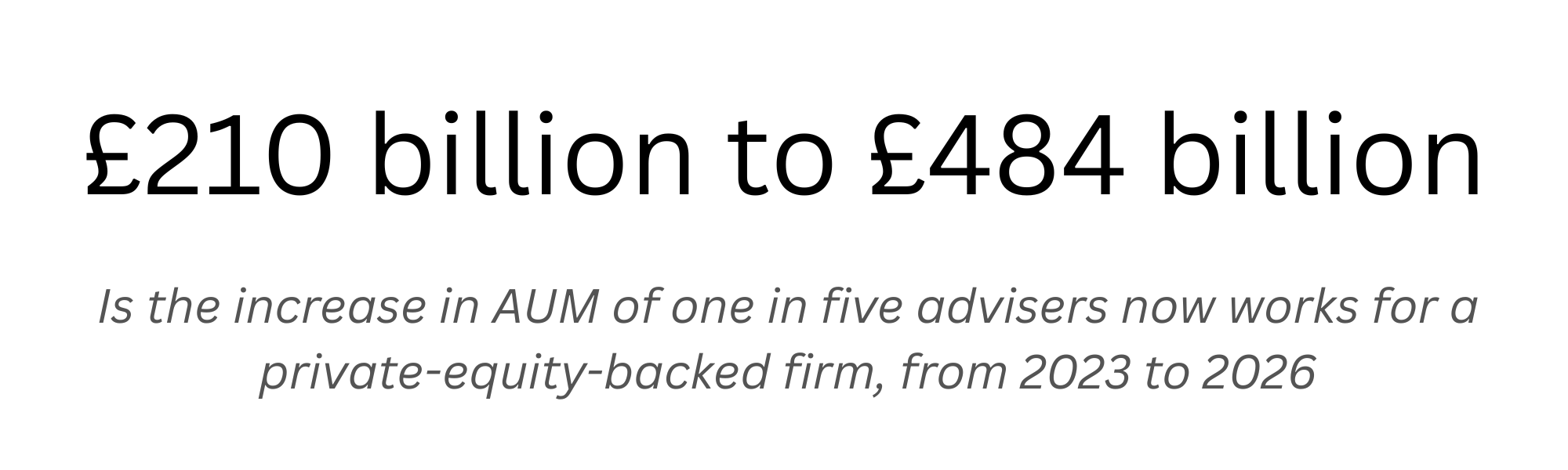
Cost.
The channels firms have always relied on to reach those clients are becoming more expensive and less productive. Organic traffic to advice-firm websites has fallen by around 45%, while the cost of the paid alternatives keeps climbing — Google CPCs are up 15% year on year. At the same time, AI is reshaping how people research and choose a provider before they ever speak to a human. Consumers can now connect their bank accounts directly to large language models and arrive at that first conversation already informed and already narrowed down.

Capacity.
Even the firms winning attention often cannot convert or serve it. Adviser time is consumed by administration and operational friction rather than high-value client work, so the same enquiry produces a smaller return than it did a few years ago. More demand, more cost, less yield.
Conclusion
Put together, these forces mean organic growth is becoming harder, more expensive and less predictable. The traditional acquisition playbook, on its own, will no longer carry an ambitious growth plan.

Interested in joining December's Briefing? Register below
Chapter 2
The trade that no longer works
When the prize is fixed, you cannot grow by simply spending more to chase the same clients through the same channels. The maths is moving the wrong way: costs up, organic reach down, competition and capital rising. Spending harder is not the same as spending well — and it is efficiency, not budget, that now separates the firms that grow from the ones that stall.
That efficiency works on two fronts at once. On acquisition: directing spend at genuinely in-market demand rather than paying ever more simply to be seen. And on operations: converting, serving and retaining that demand well enough to earn a real return on it. Leadership teams are increasingly reframing growth not as a market-expansion problem but as a productivity and business-model one — and client acquisition itself is moving from a by-product of referrals and reputation to a strategic capability: something to be measured, managed and continuously improved.

The old equation — more clients + more advisers = more growth — has broken. A different one is taking its place: smarter spend + sharper operations + better data = more growth from the same market.

Chapter 3
£121 million, unrealised
The cost of getting this wrong is not abstract. It shows up on the bottom line.
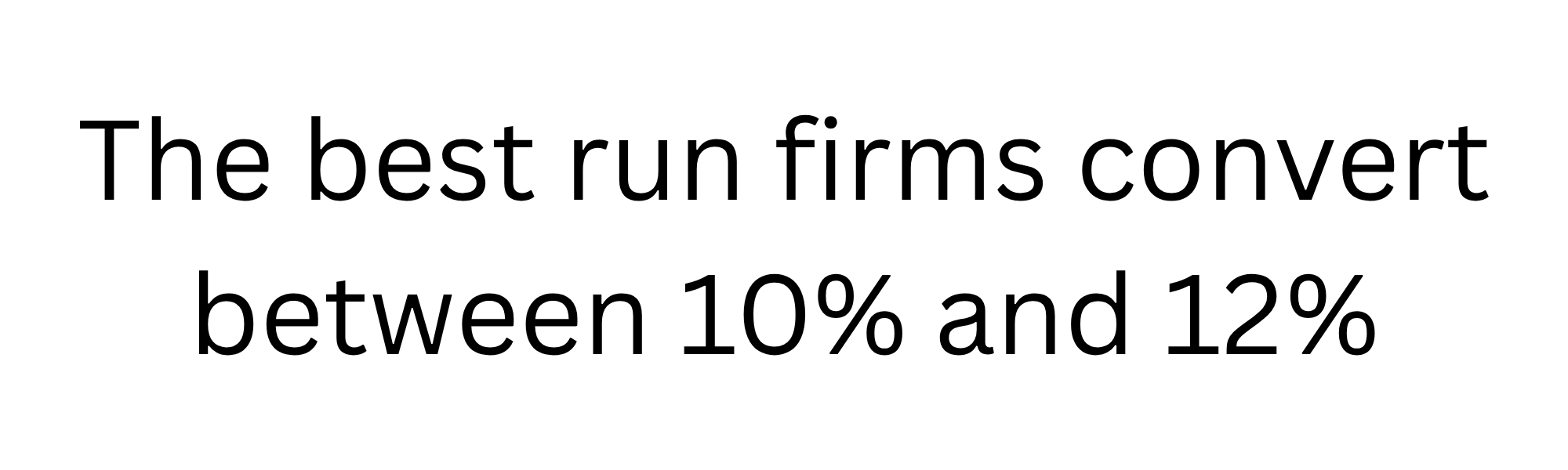
One firm we examined received 1,120 high-net-worth enquiries over twelve months and converted just 1.2% of them into clients. The market average sits around 7.8%; the best-run firms convert between 10% and 12%. Had that firm performed at benchmark on the very same enquiries, the difference would have been worth £121 million in AUM.
That gap was not a marketing failure. The demand had already been created and paid for. It was lost to slow response, weak follow-up, and a funnel no one owned end to end. Which is precisely the point: in a hypercompetitive market, funnel discipline is not an operational nicety. It is one of the largest revenue levers a firm has.

Chapter 4
Building the growth engine
If growth is now won on execution, the firms that pull ahead will be those that build a repeatable, data-led growth engine rather than relying on individual advisers' networks. Across every discussion, the same four components recur.
Understand demand.
Know who tomorrow's clients are, where they look, and what they value — then make sure you are visible there. The next generation still wants human advice, but they discover and evaluate it differently: better informed, with clearer views and higher expectations, having already used digital and AI tools to shape their thinking before the first meeting. Demographic change compounds this — the Great Wealth Transfer, rising female ownership of wealth, and shifting retirement needs are all redrawing who firms should be building relationships with. The firms that win here combine digital accessibility and personalised, behaviourally-aware engagement with the human trust that has always underpinned advice.
Convert with discipline.
Treat the funnel as revenue infrastructure. Speed to lead, structured follow-up and full-funnel tracking are what separate a 1.2% firm from a 10–12% one. This is where operating leverage is actually created.
Build a growth culture.
Technology alone does not create scalability; the foundations beneath it do. Fragmented systems, inconsistent data and unclear ownership are what stall automation and AI — not the tools themselves. A growth culture of experimentation, data-driven decisions, benchmarking and named ownership for outcomes is what lets a firm redesign itself around technology rather than merely adopt it.
Test new channels deliberately.
Find where your audience actually is, give a single owner responsibility for each new channel, and test, measure and scale only what works.
None of this displaces the relationship at the centre of advice. It protects it — by freeing skilled advisers to spend their time where they create the most value: reassurance, judgement and trust.
Conclusion
This is also, increasingly, how the market measures a firm's worth. In our CFO and senior-executive discussions, enterprise value was consistently linked less to scale and more to the quality of growth — sustainable net flows, recurring relationships and predictable performance. Bigger, on its own, no longer means better. A firm with a working growth engine is not just easier to run; it is worth more.
The next edition follows later this year. Further data and benchmarks are available at unbiased.co.uk/pro.

Does the industry's traditional adviser model remain fit for purpose in 2026
Many firms acknowledge that expecting every adviser to act as both a technical planner and an effective business developer may no longer be realistic. Increasingly, firms are differentiating between advisers who excel at acquiring new clients and those whose strengths lie in nurturing existing relationships. This has significant implications for recruitment, remuneration, career pathways and organisational design, particularly as firms attempt to balance commercial growth with high-quality client service.
Operational infrastructure was also repeatedly identified as the foundation for sustainable growth. Growth ambitions cannot outpace operational capability, with paraplanning capacity, workflow design, CRM effectiveness and data quality all emerging as critical bottlenecks. While AI and automation are expected to play an increasingly important role, firms recognised that technology only delivers value when embedded within well-designed processes and supported by high-quality underlying data.
Download the full findings here.